
We all know journaling is a very popular mental health tool. But all the hype around journaling doesn’t always come with an explanation for how journaling is helpful.
How is writing down negative thoughts helpful? Writing about your problems down doesn’t fix anything, so what is the point?
Most of us interested in improving our mental health have tried journaling, have had someone recommend we try journaling, or are just interested in journaling.
If you are anything like me, you feel intrigued about starting a journaling practice, but equally skeptical. When it comes to journaling, I realized that I just truly don’t understand how it works.

Photo by Sixteen Miles Out on Unsplash
If you relate to those thoughts, luckily for you I did a deep dive to clarify exactly how journaling can help us. Read this blog post to learn everything you need to know about
⬦what journaling is
⬦what the point of journaling is
⬦the benefits of journaling
⬦the potential downfalls of journaling
⬦why journaling works
⬦how you can journal more effectively
I also offer some food for thought to help you determine whether or not you should start journaling.
What is journaling?
Firstly, we need to define journaling. According to Therapy in a Nutshell, journaling is “[writing] about what you’re feeling, or thinking, or experiencing.”

Photo by Prophsee Journals on Unsplash
What is the Point of Journaling?
Journaling Benefits
There are a variety of potential mental health benefits associated with journaling, which is why so many people recommend this practice.
And not only can journaling improve your mental health, journaling can offer some physical health benefits as well!

Photo by Claire Morgan: https://www.pexels.com/photo/photo-of-cup-beside-books-4068029/
Journaling’s Mental Health Benefits
⬦Decreased anxiety and depression.
⬦Decreased stress.
⬦Clarity around your thoughts and challenges.
⬦Self-Reflection.
⬦You can better process your emotions.
⬦Improved mood.
⬦You can better process traumatic experiences.
⬦Support with overcoming limiting beliefs.
Many of us live on autopilot at least part of the time. We have subconscious thoughts that impact our daily lives without us realizing it.
Journaling can help you gain awareness of the subconscious thoughts driving your behaviors. This is a powerful insight that can help you change your behavioral patterns.
Read this blog post, if you want to learn more about how you can overcome your subconscious limiting beliefs.
⬦You control your thoughts, they don’t control you.
⬦ Keeping journals means you get to look back on a record of your life.
Brain coach Jim Kwik points out that looking back through our journals gives us perspective.
⬦You can track your progress towards your goals.

Photo by Prophsee Journals on Unsplash
Journaling’s Physical Health Benefits
Journaling’s Potential Downfalls
While journaling has many potential benefits, there are also some potential downfalls.
⬦Journaling might cause you to focus too much on negative thoughts.
I know that if I’m not careful and pay too much attention to my thoughts, I can start to overthink and spiral.
Luckily there are ways to avoid these downfalls. Later in this post, I share some tips to help you journal in a way that is helpful, not harmful.

Photo by Ann poan: https://www.pexels.com/photo/opened-diary-placed-on-table-near-mug-and-candle-5797906/
Why Does Journaling Work?
Surprisingly, I couldn’t find a lot of clear information on why journaling works. But here is some information I found that might explain how journaling gives us the benefits we discussed.
Catharsis
Journaling about intense experiences can provide you with a cathartic release. The act of getting those thoughts out of your head and into a journal can help you let go of strong emotions.

Journaling Changes Your Brain
Journaling Lets You Externalize and Analyze Your Thoughts
Sometimes we get so close to our thoughts that we forget to analyze them objectively.
I know I sometimes have to remind myself that I don’t need to take my thoughts at face value.
Journaling for Self-Improvement
Journaling helps you get to know yourself better. Through writing and reflecting, you can start to identify patterns in your life.
Once you identify patterns that you aren’t happy with, you can take steps to improve.
Journaling Forces You to Confront Your Problems, Instead of Avoiding Them
People typically want to avoid negative emotions. But, journaling can evoke these emotions, and repeated exposure works to strengthen your ability to accept them. Learning to accept your emotions helps your overall well-being.

Photo by Blake Wisz on Unsplash
Journaling Helps You Create Narratives
Journaling helps you organize your thoughts and make sense of situations. Creating a cohesive narrative out of traumatic memories can help you better process those memories.
Writing this blog post gave me inspiration for a journaling activity I’m going to do myself. I’ve had a few negative job experiences in my life. I know I still carry around negative thoughts and stress from those experiences.
So here is how I plan to journal:
First, I am going to journal about these experiences. I am going to write about all of the stressful scenarios and negative thoughts associated with those jobs.
Then, I am going to write another journal entry about these experiences and describe everything I learned and took away from those jobs. I am going to identify all of the positive aspects of those job experiences.
I intend to rewrite those stories in a way that feels more empowering and helps me let go and move on.

Photo by Ann poan: https://www.pexels.com/photo/opened-notebook-with-pen-on-white-desk-5797900/
How to Journal More Effectively
As I mentioned at the beginning of this post, journaling does have some potential downsides. So I came up with some tips that can help you journal about negative thoughts in a helpful, not hurtful, way.
Set Your Intention Before Journaling
Ask yourself what you want to get out of journaling.
Setting your intention can help you redirect your journaling practice if you notice any of the potential downsides creeping up.
Knowing why you want to journal can also help you stay motivated to keep up with the habit and will help you determine the most effective way for you to journal.

Photo by Prophsee Journals on Unsplash
Journal About Your Experiences and Feelings, but Don’t Identify With Them
I got this advice from someone I trust when it comes to mental well-being. Be careful about the language you use when journaling. Make sure to observe your experiences without identifying with them.
For example, you could write:
I noticed I was feeling overwhelmed at work. Whenever I have a lot of deadlines, I get stressed.
Instead of
I am so bad at my job. I can’t manage all these assignments. I can’t handle this stress.
Use Your Journal to Reflect, Not Just to Vent
Journaling can be a healthy form of venting. But, you have to do more with it than just write your thoughts down.
In order to tap into journaling’s positive benefits, you need to use your journal to reflect and take action.
Photo by Gabrielle Henderson on Unsplash
Journal About Positive Thoughts as Well
You might know the saying “Where focus goes, energy flows.” This tells us that what we choose to focus on creates our reality. Understanding this gives you the power to create your desired reality.
Make sure you also journal about the positive things happening in your life.
You can write about anything from fun plans with friends, to your favorite habits, to brainstorming your future goals. Anything that makes you feel good.
Writing about positive topics makes you feel good in the moment and also helps you start to notice more positivity in your life.
I’ve been keeping a gratitude journal for several years, and I love this practice. Every night, I write down some things I’m grateful for. I find this uplifting.
My gratitude journal is something that I know can bring a smile to my face every day.
I would recommend gratitude journaling to anyone who wants to maintain a more positive attitude.
Make Sure to Remain Non-Judgemental and Self-Compassionate
As with any self-care tool, it is important that you remain non-judgemental and self-compassionate when journaling. This is especially important when you are writing about emotionally charged topics.
Photo by Susan Weber on Unsplash
Choose a Journaling Method That Works for You
There is no right or wrong way to journal. Different methods work for different people. I listed out some popular journaling methods, so you can take a look and see if any sound interesting to you.
Diary
Some people enjoy the classic, diary-style journaling, while others do not. This is where you simply keep a log of what is going on in your life.
You could do this daily, or you could try recording everything that happened over the week.

Expressive Writing
Expressive writing is a popular wellness journaling practice, which can lead to improved physical and mental health.
As the name suggests, expressive writing involves writing to express your thoughts and feelings. Expressive writing doesn’t require formal writing skills and can take any form.
Journal Prompts
Journal prompts offer a more guided journaling approach. Using journal prompts can be helpful if you are new to journaling and don’t know where to start.
You can purchase journals that come with journal prompts, such as The Five Minute Journal, or you can find journal prompts online.
If you want to write about a specific topic, you can search for [your topic] + “journal prompts” or search “beginner journal prompts.”

Photo by Prophsee Journals on Unsplash
Morning Pages
Morning Pages come from The Artist’s Way by Julia Cameron. Morning Pages is a practice of filling three pages with stream-of-consciousness thoughts, first thing in the morning.
Write everything and anything that comes to your mind without editing or censoring.
I remember a brief period when I did Morning Pages in college. I found it helpful to get my thoughts out before doing anything else.
Brain Dump
The Brain Dump is one of my favorite journaling methods.
You know those days when your mind is racing nonstop? When you feel particularly stressed and anxious and you find yourself overthinking things?
A Brain Dump can help you get relief from those racing thoughts.
This is very simple. Just take a blank piece of paper (or your preferred journaling method) and write down everything on your mind.
Think of this as clearing the clutter out of your mind. Getting all your thoughts into your journal can help you feel more calm and clear-headed.
You can even destroy the paper afterward if that feels helpful!
When I talk about my intention to journal more often, I am referring to brain-dump style journaling. I think I would benefit from taking time to release my thoughts by getting them out of my head and onto paper.
Lately, I have been experimenting more with writing down any intrusive thoughts that are bothering me. I’ve found it helpful. If anything, just knowing that I am doing something proactive to improve my mental health makes me feel good.
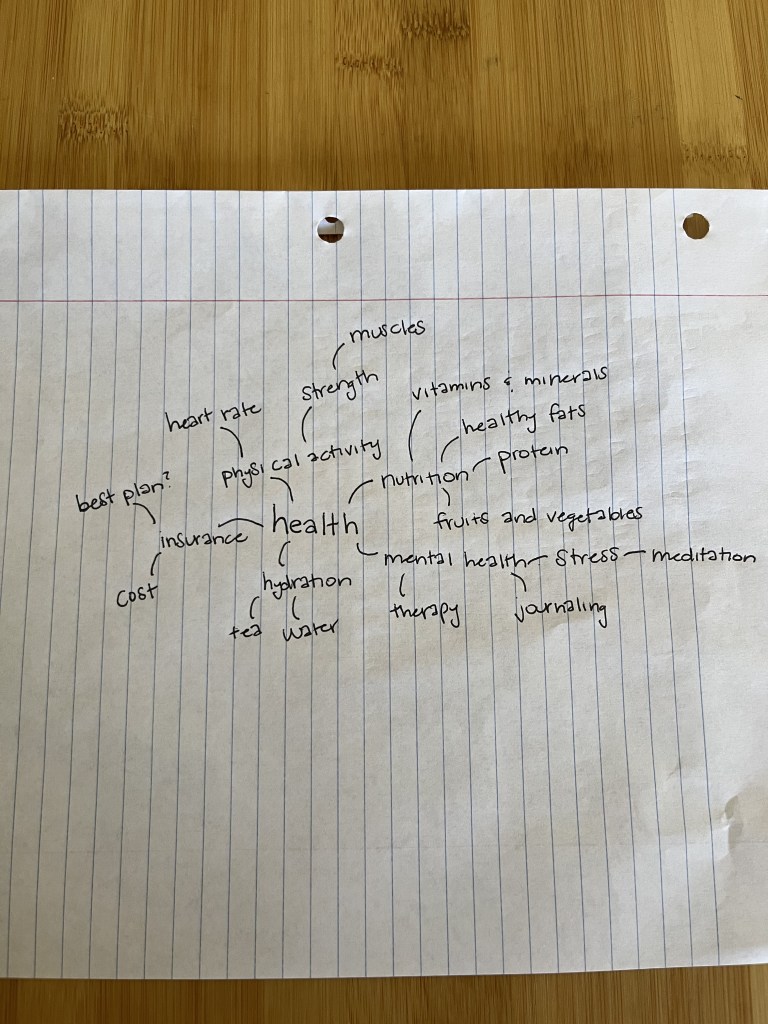
Mind Mapping
Mind mapping is another way for you to organize your thoughts.
Start by selecting a topic. You can create a mind map about a particular worry or stressor in your life. For example, your topic might be your health.
Once you select your topic, you will write all the thoughts you associate with that topic, using a line to connect each association to the original word.
You will then continue attaching associations to each word until you have several levels of associations.

Photo by Olha Ruskykh: https://www.pexels.com/photo/open-diary-near-laptop-on-crumpled-bed-at-home-5984622/
Pen and Paper or Digital Journal?
There are many ways to journal, but the best journaling method is the one you’ll keep up with.
Personally, I prefer physical journals over journaling apps or a Google Doc. But this is personal preference.
You can try both and see which you like better.
There is also no rule that says you can’t keep a physical journal and a digital journal.
That said, there are some benefits to writing by hand that I want to share.
⬦Handwriting slows your thoughts.
⬦Handwriting commits things to memory.
Fun fact, I used to study for my college exams by creating flashcards and writing out the answers by hand. I found this studying method very effective and this helped me recall the information during my exams.
I also find handwriting very soothing.

Photo by cottonbro studio: https://www.pexels.com/photo/a-variety-of-writing-notebooks-5191390/
Should You Journal?
Journaling doesn’t work for everyone. And that is okay!
Many of us, myself included, feel pressure to practice all the healthy habits we hear about from others. But if journaling doesn’t work for you, that is completely fine!
If you do find journaling helpful but struggle to journal consistently, I want to share this advice I got from Hayley Honeyman on YouTube.

Photo by Markus Winkler on Unsplash
The advice is to journal when you feel compelled to do it! This sounds simple, but what Haley was saying is that anytime you notice yourself feeling called to journal, journal in that moment, instead of putting it off for later.
If you are anything like me, you tell yourself that you will do something later, but “later” doesn’t always come. We know that motivation is fleeting, so it is important to take advantage of it when you can!
How Often Should You Journal?
A lot of people recommend daily journaling. But should you really journal every day?
Only journal every day if that makes sense for you. If trying to journal every day sounds unrealistic to you, putting that pressure on yourself is going to counteract journaling’s positive benefits.
Only you can determine the journaling frequency that works for you!
I hope this post helps you understand how journaling can help you. Do you currently journal or are you interested in starting a journaling practice? Leave a comment to let me know your thoughts on journaling!
Thank you for reading! Make sure to sign up for my email list to get notified of new blog posts with tips to help you become the best version of yourself! And make sure to follow me on social media (links below) to stay connected and receive more positive lifestyle and self-improvement tips!
Featured Image: Photo by Sixteen Miles Out on Unsplash
 Life by Julia
7 thoughts on “What is the Point of Journaling? How Does Journaling Improve Your Mental Health?”