
Do you feel like you don’t have enough time to do everything you want to do?
If so, you are not alone!
I often feel overwhelmed at the thought of scheduling enough time for everything that matters to me—a full-time job, content creation, social life, family, self-care, hobbies, etc.—and this mental balancing act can feel exhausting and frustrating.
When was the last time you felt content with how you were spending your time? I’m experimenting with different strategies to help me use my time more mindfully.

Photo by Michaela: https://www.pexels.com/photo/flat-lay-photography-of-unfold-book-beside-macbook-295826/
Finding balance can feel challenging, but it is an important step that can help us avoid burnout, even if this balance doesn’t look like what you expected.
While many of us feel attracted to the thought of doing more in less time, there is something to be said about accepting our limited time.
4 Thousand Weeks: Time Management for Mortals by Oliver Burkeman offers helpful mindset shifts for making peace with the concepts of time management and productivity.
One thing Burkeman discusses in this book is that, realistically, you won’t accomplish everything on your To-Do List. He proposes that we can find greater satisfaction by accepting our time constraints and making the most of the time we do have.
This mentality allows you to avoid the disappointment that comes with setting unrealistic expectations.
If accepting that you actually can’t do it all makes you feel uncomfortable, you’re not alone! It’s hard to accept this reality.
That said, even if we can’t do it all, we can still learn to use the time we have more efficiently!
Awareness is Key to Better Time Management
The first step to using your time more efficiently is to gain awareness of how you currently spend your time.
In my experience, lack of awareness can lead to wasted time.
You might think you know how you spend your time, but there are probably more time-sucking activities throughout your day than you realize.
Sometimes, I look back on my day and realize I have no idea what I was doing.
With some encouragement from my support system, I decided it was finally time to conduct a time audit to get a clearer idea of how I spend my time.
I’m not the only one who sees this as a helpful exercise.
This blog post will walk you through what a time audit is, how a time audit can help improve your time management, and the steps to follow to conduct a time audit.
What is a Time Audit?
An “audit” is “a methodical examination and review.”
So, a “time audit” means carefully examining and reviewing how you spend your time.
Now, how can you use this tool to improve your time management skills?
How Can a Time Audit Help You With Time Management?
Crafting a lifestyle that allows you to balance your priorities without feeling unnecessarily overwhelmed requires time management skills.
Yet, many of us find it challenging to judge our time management habits. Keeping track of your time management gives you concrete evidence to work with.
Time Audit Benefits
♦ You can gain more awareness of how you spend your time.
♦ You create opportunities to re-evaluate how you spend your time.
♦ You might discover pockets of wasted time (which you can dedicate to a meaningful goal).
Goals to Keep in Mind When Auditing Your Time
♦ Find out where you are wasting time.
♦ Find out if any activities take longer than necessary.
♦ Analyze if how you spend your time aligns with your goal.
Now that you know what a time audit is and how it can benefit you, let’s go over the steps to conduct a time audit.
How to Conduct a Time Audit: A Step-By-Step Time Audit Guide
These are the steps I’m using to audit my time, so I can assess whether I’m spending time in a way that furthers my goals. Please join me in following these steps over the next few weeks!
- Find a simple method to record how you spend your time.
Find a simple time-tracking method. Pick a method you can, realistically, keep up with for a few days (at minimum).
Time Tracking Methods
These are a few simple time-tracking methods you can try.
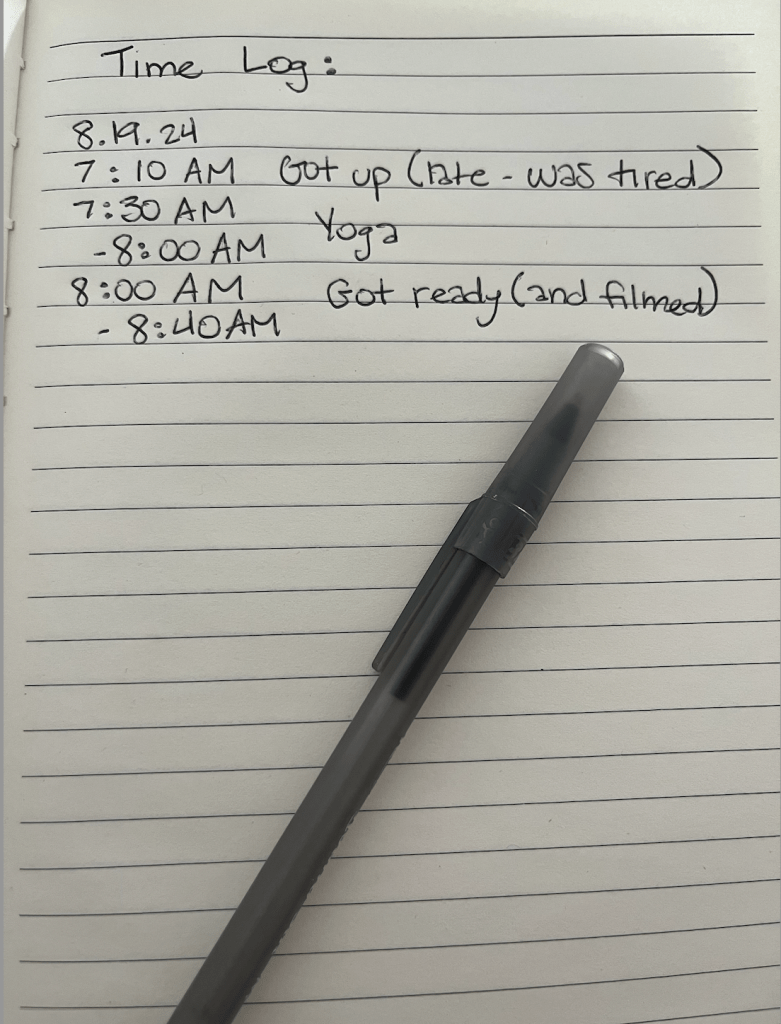
Journal
If you like pen and paper, you can keep a journal log and write down your daily activities and how long they take.
You can also jot down any relevant notes, such as how you were feeling. This can provide more context for later steps.

Toggl
You can also use an app, like Toggl, to track how you spend your time. Toggl is a time-tracking software that records how long you spend on different activities.
This free app is very simple to use! You just start the timer and categorize the entry with the task you’re working on.
Toggl will log how long these tasks take and can create reports to give you insight into your time management.
While Toggl is marketed to help businesses keep track of projects to create accurate invoices, you can also use this software to keep track of your daily activities.
Toggl is how I like to track how I spend my time!
- Determine How Long You Want to Track Your Time
Ideally, you want to monitor your time for at least a week or two. This will give you a more accurate data set to analyze. Monitoring yourself over a longer period will also give you insight into your patterns across different contexts, such as weekdays and weekends.
- Keep Physical Records
However you decide to track your time, make sure that you keep physical records. Do not rely on your memory.
Remember when I said I can look back at long periods and not know what I did? I can’t rely on my memory to tell me how I spend my time.
Whether you write everything down on paper, or use an app like Toggl, having records to look back on will give you a more accurate picture of your habits.
- Analyze How You Spend Your Time
This step is extremely important! Look over your records and analyze how you currently spend your time. These are some reflection questions to guide you:
♦Are you spending time on activities that don’t align with your values?
♦Are there activities that take longer than necessary?
♦Do you want to reallocate time from one activity to another?
This is your opportunity to make intentional decisions about how you spend your time.
You get to determine if you want to reallocate time from lower-priority activities to higher-priority activities.
If a time audit sounds like a lot of work, I get that. But think of it this way:
A few weeks of effort can give you the necessary insight to make some serious positive changes to how you spend your time.
A time audit might be just what you need to improve your time management!
I hope this post helps you! I’d love to hear how your time audit goes! What surprised you the most about how you spend your time? Leave a comment to share your experience and any insights you gained!
Thank you so much for being part of this community. I love sharing tips to motivate others to create their dream lives!
Make sure to sign up for my email newsletter to get notified of new weekly blog posts. And, follow me on social media (links below) to stay connected and receive more content with tips to help you live your best life.
 Life by Julia